

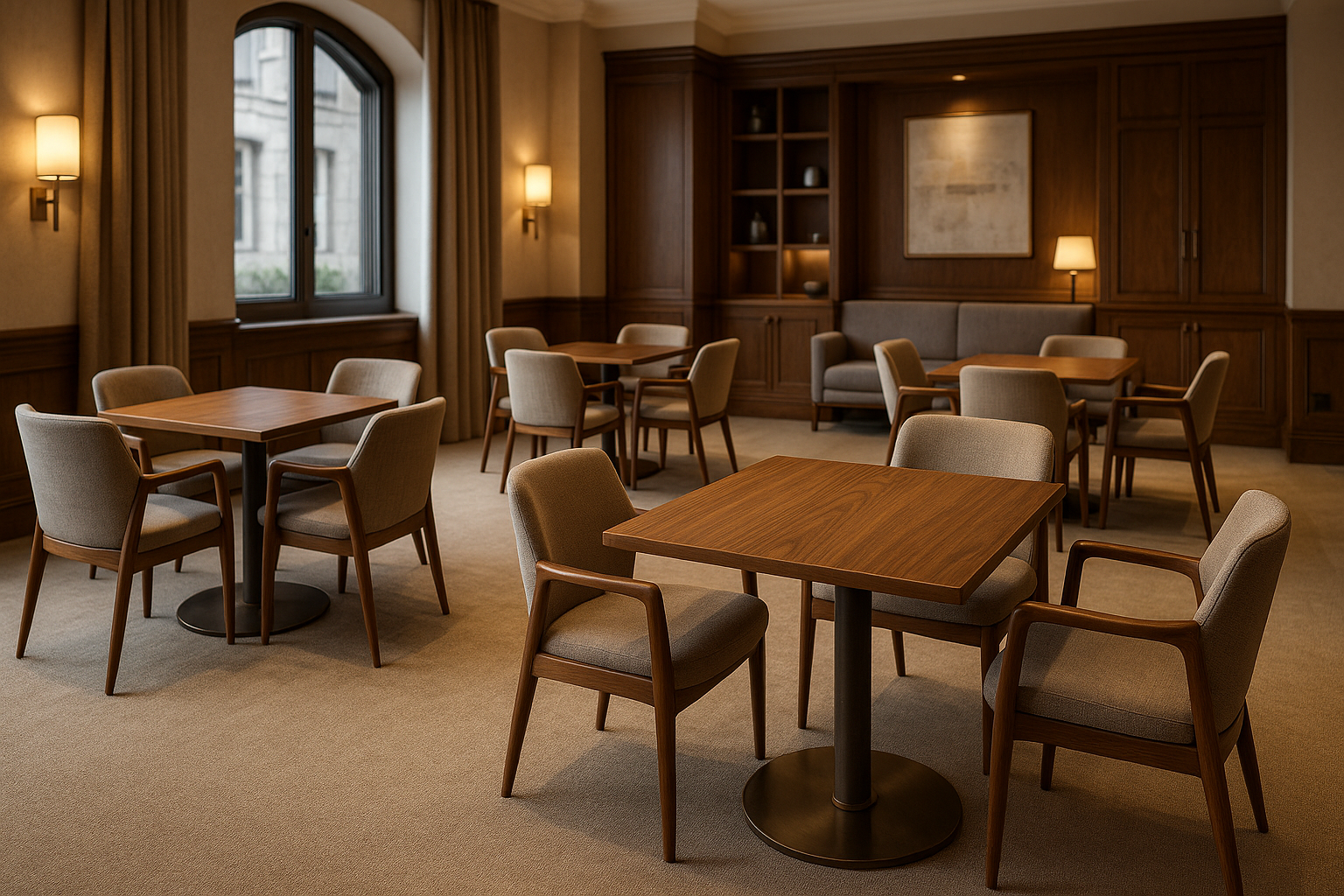
In the hospitality industry, design decisions are business decisions. The furniture that defines a hotel or restaurant’s aesthetic also determines its long-term cost, maintenance, and brand consistency. At Hicks Furniture, we view every commission as an investment in longevity — built to perform for years, not just opening night.
Durability, repairability, and design timelessness are not expenses; they are assets that protect ROI, reduce replacement cycles, and reinforce brand integrity over time.
The True Cost of Short-Term Design
Fast procurement may reduce upfront costs, but it often introduces hidden expenses — premature wear, inconsistent finishes, and frequent replacements. Research in hospitality asset management shows that FF&E replacement represents up to 15% of total renovation budgets every seven years (IHG, 2023).
By contrast, high-quality, repairable furniture extends replacement intervals by 40–60%, saving significant capital expenditure across the asset’s lifecycle. In hospitality, where perception and performance must align, durability equals profitability.
Designing for Lifecycle Value
Hicks Furniture approaches design through a lifecycle lens — assessing not only aesthetics but also structural performance, serviceability, and ease of maintenance.
Our design process prioritizes:
- Durable frameworks: kiln-dried hardwoods and reinforced joinery tested for commercial load standards (EN 16139).
- Replaceable components: removable tops, cushions, and fittings to simplify repair.
- Finish longevity: high-abrasion coatings, low-VOC lacquers, and water-resistant veneers for high-traffic environments.
- Timeless proportions: adaptable designs that remain relevant through brand evolution.
This method aligns with the principles of Total Cost of Ownership (TCO), reducing lifecycle cost per use and improving overall asset performance.
Material and Structural Integrity
A chair is only as strong as its joint. Hicks Furniture uses time-tested joinery techniques — mortise-and-tenon, dowelled, or CNC-reinforced structures — designed to outlast daily use.
A 2024 study in Building Research & Information found that furniture durability can reduce embodied carbon by up to 35% when replacement frequency is decreased (Petrović et al., 2024). By specifying dense hardwoods, engineered substrates, and eco-certified finishes, Hicks Furniture ensures both structural and environmental longevity.
Durability as Sustainability
Longer-lasting furniture is inherently sustainable. Each year of extended service life delays manufacturing emissions, transportation impact, and landfill waste. Hicks Furniture builds for maintenance — not disposal — allowing refurbishment and refinishing long after installation.
This approach supports LEED and BREEAM certification pathways under the “Materials and Resources” credits, satisfying both environmental goals and investment metrics.
Predictable Performance and Brand Consistency
Inconsistent quality erodes guest trust and operational efficiency. When furniture in a hotel chain varies in appearance or wear, brand image declines. Hicks Furniture’s controlled production process maintains dimensional accuracy, material uniformity, and repeatable finishes across multiple sites.
The result is predictable performance — furniture that supports consistent guest experience while minimizing downtime and replacement costs.
Lifecycle ROI: The 10-Year View
A 2023 analysis by the International Journal of Hospitality Management found that upgrading to high-grade joinery and contract furniture increased average service life from 6.2 to 10.1 years, resulting in a 27% lower total cost of ownership (Nguyen & Zhao, 2023).
For a 100-room hotel, that translates to tens of thousands in deferred capital expenses — while maintaining higher brand ratings through durability and aesthetics. Hicks Furniture’s production model, combining handcrafted detail with digital precision, ensures that lifecycle advantage.
Maintaining Value Through Refurbishment
Even the best furniture requires maintenance. Hicks provides refinishing, reupholstery, and component replacement services to extend the useful life of existing installations.
This not only reduces replacement frequency but also preserves design coherence. In many cases, refinished Hicks pieces are reinstalled during refurbishments, maintaining visual continuity across decades of use.
Conclusion: Longevity as Design Philosophy
Longevity isn’t just a manufacturing principle — it’s a philosophy of stewardship. Every well-built chair or cabinet represents less waste, lower cost, and a more stable brand image.
At Hicks Furniture, our goal is simple: to craft furniture that performs as an investment — one that looks as strong in its tenth year as it did on day one.
References
IHG Hotels & Resorts. (2023). Sustainable FF&E management in hospitality operations. IHG Corporate Publications.
Nguyen, H., & Zhao, R. (2023). Furniture lifecycle performance and asset value in the hospitality industry. International Journal of Hospitality Management, 109, 103481. https://doi.org/10.1016/j.ijhm.2023.103481
Petrović, M., Smith, L., & Zhang, Y. (2024). Product longevity and embodied carbon in interior fit-outs: A lifecycle perspective. Building Research & Information, 52(4), 385–398. https://doi.org/10.1080/09613218.2023.2301267
